Why does USPSA use hit factor?

LuckyDucky

Well-Known Fanatic
Joined
Jul 17, 2011
Messages
1,696
Reaction score
369
City & State/Province
Oklahoma City, OK
*Please note, this thread is not about stupid IDPA rules unrelated to scoring.

Any idea why USPSA scores (hit factors) are inversely related to time?

This puts a huge emphasis on having a lower time at the expense of accuracy.

Other competition styles such as IDPA, steel challenge, and GSSF all have direct relations between score and time. So shooting/moving faster does not exponentially increase score.

For example, Shooter A, a USPSA major shooter, might shoot a stage in 5 seconds with 1 no shoot and 1A, 2Cs, and 1D (5 points) for a hit factor of 2. Using IDPA scoring, Shooter A would have 7.5 penalty seconds giving a total time of 12.5 seconds.

But Shooter B, another major shooter, might shoot the same stage in 10 seconds with 2As and 2Cs (18 points) for a hit factor of 1.8. But using IDPA scoring, Shooter B has only 1 penalty second for a score of 11 seconds.

So Shooter B shot slower, but more accurate, and loses in USPSA but wins in IDPA.

Hopefully someone will see what I'm getting at...

But to sum it up, in USPSA, Time > Accuracy because time is inversely related to final score and this places a much larger emphasis on speed than accuracy.

My question is why? Why score this way?
 
why not?
It's a game base on points/time. That's the way the creators of the game set it up.
They obviously put a greater emaphasis on time vs accuracy, just as the creators of IDPA emphasize accuracy. Why does one have to be right & the other wrong? Shoot what suits you.

Also, if you like USPSA but favor accuracy over time, shoot it that way.
If you would rather "win" shoot it to get as many points & as few penalties as fast as you can.
Truth is, this is how it should be done in either.
 
I see where youre getting at.
But until someone shows me someone who misses fast enough to win, I will always maintain that accuracy is important.
 
mike cyrwus said:
I see where youre getting at.
But until someone shows me someone who misses fast enough to win, I will always maintain that accuracy is important.
I don't disagree. My personal shooting mission is to "get better" and that can be done in USPSA or IDPA, but I find USPSA to be more fun.

But I do believe USPSA is more forgiving for inaccurate shots for the reason I mentioned in my first post and because mistakes don't necessarily carryover between stages.

You can make a big mistake in a low points stage and it won't matter very much if you ace all the high point stages.
 
No one has ever won a match with serious competition shooting less than around 92% of the target points. USPSA is accuracy intensive because of the good shooters who shoot alphas at breakneck speed. Good shooters absolutely rake in the target points.
 
As an Amazon Associate we earn from qualifying purchases. Product prices and availability are accurate as of the date/time indicated and are subject to change.
technetium-99m said:
No one has ever won a match with serious competition shooting less than around 92% of the target points. USPSA is accuracy intensive because of the good shooters who shoot alphas at breakneck speed. Good shooters absolutely rake in the target points.
I certainly won't beat mike cyrwus at the next match by sacrificing some accuracy for speed, but I could definitely move up a little bit in the rankings. The difference doesn't matter for competitors with vastly different skill levels, it affects those that are similar.

slower but more accurate wins in IDPA but loses in USPSA for people of similar skill levels.

My question is why set it up this way? I've googled for reasons for the scoring system (since everything else uses time+), and I can't find much except general history of USPSA/IPSC or explanations of how it works.
 
Spencer said:
slower but more accurate wins in IDPA but loses in USPSA for people of similar skill levels.
Because IDPA is a simpler game.


But back to your original question.
In 1976, in Columbia Missouri, IPSC was formed "with no authority but our own enthusiasm"
They choose Col Coopers brainchild as its scoring system.
It recognizes power, and rewards a balance of speed and accuracy. The entire premise of the sport is 'DVC'

Time plus scoring is a more simple method, invented for more simple games.
You cant compare IDPA vs USPSA scores because the targets are so different.
Steel Challenge only recognizes time, accuracy is a pass/fail...if you dont hit the target, your time wont matter.

TGO said that if you're not fast enough, it wont matter how accurate you are.

Accuracy matters...try shooting Production Minor...the fastest guys arent usually the winners.
 
Spencer said:
slower but more accurate wins in IDPA but loses in USPSA for people of similar skill levels.
You think so, but you dont really know. Youre speculating.
You just have to keep shooting; your opinions will most likely change.

You are tapping into an enigma that is personally subjective.
What is fast? What is accurate?

Ive said "I should have gone faster" as much as "I should have slowed down"
beginners say the former, those of us that have done this awhile say the latter.

It doesnt matter what sport, idpa, ipsc, 3gun

Spencer, Im not playing around with you, I respect your musing.
 
OK so I'm a C-class nobody but I'm OK at math

Spencer said:
*Please note, this thread is not about stupid IDPA rules unrelated to scoring.

Any idea why USPSA scores (hit factors) are inversely related to time?

This puts a huge emphasis on having a lower time at the expense of accuracy.

Other competition styles such as IDPA, steel challenge, and GSSF all have direct relations between score and time. So shooting/moving faster does not exponentially increase score.
It has nothing to do with inverse/direct relations. In both sports, less time is better so there's an incentive to go fast no matter what.

What matters is the change in your score between a good hit and a bad hit. If you changed the USPSA point system so that an Alpha was 10 points instead of 5 points, I bet shooters would pay a lot more attention to accuracy. You can see this in the difference in pace between dudes shooting Minor and Major. Similarly, I bet IDPA would turn into a total hosefest if you changed "down 1" to be +.1 seconds instead of +.5 seconds. I have no idea how Jeff Cooper picked the constants he did, but IDPA just deliberately picked them to be more "accuracy-focused" than IPSC.

The real difference between the two scoring systems is that hit factor normalizes for stuff like shot difficulty. Let's say we have a hoser stage with 15 paper targets (75 points possible). It takes a theoretical perfect shooter (we'll call him Accurate Ron) 10 seconds to shoot the stage, meaning it has an ideal hit factor of 7.5. None of us are Accurate Ron, so we have to figure out whether we're more comfortable giving up speed or points. Giving up one Charlie in the same amount of time (shooting Minor) yields a hit factor of 7.3. Do some algebra and you find out that has the same impact to your hit factor as losing .27 seconds of time.

Now let's take a stage with the same number of points possible, but there's a lot of running around and long shots so it takes Ron 25 seconds and our ideal hit factor is 3. A Charlie hit on this stage yields a hit factor of 2.92; shooting all the points, that's equivalent to a .68 second increase in time so it makes sense to take more time on the longer shots.

Let's compare this to IDPA. In a parallel universe where IDPA stages are long enough to be fun, we have the same 15 target stage with an ideal time of 10 seconds. Time-plus scoring makes this simple: one "Charlie" hit loses you .5 seconds of time. Before, where making up a Charlie might not have made sense depending on your split times and stage plan, now it almost certainly would. So IDPA is more accuracy-intensive, right?

Go back to the hypothetical 3 HF stage, where a Charlie hit is the equivalent of .68 seconds added to your time. However, that same hit in IDPA still costs the same .5 seconds as it did in the hoser stage. In this case, it's conceivable that for a shooter of a certain skill level where it takes between .5 and .68 seconds to shoot that makeup shot with a high degree of probability of a -0 or A hit, it makes sense to make up that shot in USPSA but not in IDPA.

I'm not sure if that really proved anything; it's a simplistic analysis and I just pulled the point values and times out of my ass to make the math easier so they may not actually reflect reality. Point being, in USPSA the focus on accuracy depends entirely on the kind of stage it is. Stages where Accurate Ron posts a high hit factor means more points per second, meaning speed is valued more over accuracy. However, the lower Accurate Ron's HF is the more highly valued accuracy is. However, in IDPA a down 1 hit always costs you .5 seconds no matter what. There's a point where it makes sense to be less accurate on harder shots.
 
I just did all that math assuming there's only one A hit required per target. elephant dung.

Whatever, the concept still works.
 
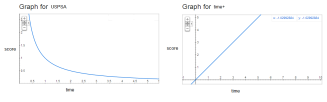
poopgiggle, I wasn't using the correct terms. I should have said that time+ scoring is linearly related while hit factor scoring is not.

It is true that under both systems, the penalties could be adjusted to prioritize accuracy, but I don't believe that has truly been done in USPSA. I believe the balance generally favors speed. Sufficient accuracy + excellent speed = win

I do like your parallel universe where IDPA stages are long enough to have fun. :sarcastichand:


View attachment 7313
 

Attachments

  • Untitled.png
    Untitled.png
    20.5 KB
mike cyrwus, I'm pretty confident that what I'm saying is right, but I haven't mathematically proven it or anything.

Fast = less time

Accurate = all A hits

That wasn't so hard lol
 
For every stage shot there is a point of mathematical equilibrium and it becomes linear. It applies to everybody in all divisions and classes.

What Tony said about it be points/sec/fastest wins and Mike said about not missing fast enough to win? Really it's true.

I could go out and shoot against Mike doing a simple Bill Drill. If we took the draw out of it to eliminate that variable and start from low ready I could be very close to Mike on split times. Where Mike would kick my ass is he would have all A's and I would not. I suspect we'd be running about .18/.20 splits. I just can't shoot enough faster than that to win with C's and D's because the gun won't cycle enough faster to get there.

Another example is I can run Bill Drills with my 625 revolver shooting major loads. Taking out draw time I can reliably run .23/.25 splits. But I can't shoot all A's at that speed. To get all A's, the best I've ever done with that gun is around .33 splits and that was a "good" one.
 
Spencer said:
attachicon.gif
Untitled.pngpoopgiggle, I wasn't using the correct terms. I should have said that time+ scoring is linearly related while hit factor scoring is not.

It is true that under both systems, the penalties could be adjusted to prioritize accuracy, but I don't believe that has truly been done in USPSA. I believe the balance generally favors speed. Sufficient accuracy + excellent speed = win
USPSA favors speed up to a certain average shot difficulty, after which it favors accuracy more. That will be true no matter what since it's how the math works; where the crossover point is just depends on how much points and time penalties are chosen on either side.

You seem to be operating under the assumption that USPSA favors speed too much, which is a qualitative statement that I can't really help you with. However, saying that IDPA scoring always favors accuracy over speed more than USPSA is incorrect. That's all I was getting at.
 
Quote from above

But back to your original question.
In 1976, in Columbia Missouri, IPSC was formed "with no authority but our own enthusiasm"
They choose Col Coopers brainchild as its scoring system.
It recognizes power, and rewards a balance of speed and accuracy. The entire premise of the sport is 'DVC'

Before 1976 the action sports was Leather Slap at Knots Berry Farm. (If memory is correct)
The Accuracy sport was bullseye or NRA precision pistol

Great Shooters are Fast and Accruate and no mater what the scoring system is they will finish at the top
 
poopgiggle said:
USPSA favors speed up to a certain average shot difficulty, after which it favors accuracy more.
This was exactly what I was trying to say.

Also USPSA and IDPA each are measuring something. What that specific "something" isn't necessarily the same thing.
 
Also I think that if a USPSA MD makes the shots in his matches hard enough to be over that "crossover point," the shooters will throw a total shitfit.
 
poopgiggle said:
Also I think that if a USPSA MD makes the shots in his matches hard enough to be over that "crossover point," the shooters will throw a total shitfit.
But they can also do the opposite...the 2013 Production Nat'ls had lots of close, open targets...but if you didnt get the A's, you were screwed. I wouldnt say that the pro's 'slowed down' but it was impressive to see them exercise patience. It had to be tempting to hose.

IDPA matches do nothing but try to slow you down...every aspect of IDPA is a speedbump. From the vest to cover, no speed reloads, target engagement order, etc. It is specifically designed to nullify speed, even if they dont have any 'hard' shots.
 
Back
Top